Commercial Sewer Line Services in Southaven, MS: A Business Owner's Guide
Published: 2026-10-10
A sewer failure at a home is a bad day. A sewer failure at a business is lost revenue, health-code trouble, and customers who do not come back. Commercial sewer lines work harder than residential ones — higher volumes, grease, food solids, paper products from public restrooms, and long lateral runs under parking lots — so they fail in different ways and need a different service approach. This guide covers what commercial sewer service actually includes and how Southaven business owners should plan for it.
Whether you run a restaurant on Airways Boulevard, a retail strip, an office building, or a multi-tenant property, your sewer system is infrastructure your business depends on every hour you are open. Understanding the services available — inspection, cleaning, repair, and replacement — lets you budget sensibly and avoid the kind of emergency shutdown that costs far more than the repair itself.
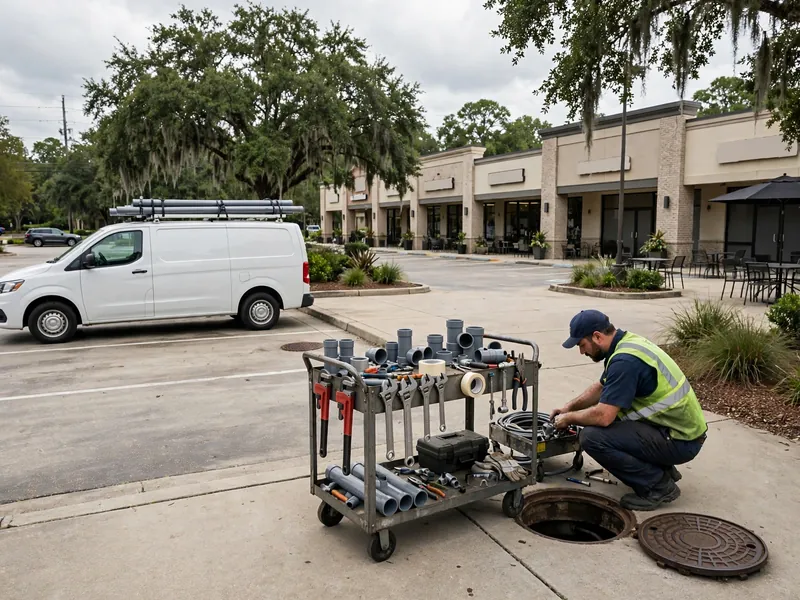
What Makes Commercial Sewer Systems Different
Commercial laterals are typically larger in diameter and longer than residential lines, often running under parking lots, loading areas, and landscaped setbacks before reaching the municipal main. They carry waste from multiple fixtures used simultaneously — think lunch-rush restrooms plus a commercial kitchen — which means peak flows far beyond what a home produces. Grease is the defining commercial problem: restaurants, cafeterias, and food processors send fats, oils, and grease down the line, and once grease cools it congeals on pipe walls, narrowing the pipe and catching everything behind it.
Regulatory pressure is the other difference. A restaurant with a sewage backup can face closure by the health department until the problem is resolved and the space is sanitized. Property managers have lease obligations to tenants, and a backup in one unit can create liability across the building. That is why commercial service is built around prevention and speed: scheduled sewer line cleaning to keep grease and solids moving, rapid-response repair capacity, and documentation you can show an inspector or an insurer.
Core Commercial Services, Explained
Commercial sewer camera inspection is the diagnostic foundation. Before any repair, technicians map the line's condition, locate blockages, measure pipe diameters, and identify materials — older commercial buildings in Southaven may still have cast iron or clay laterals, while newer construction is usually PVC. Inspections are also how you verify that a repair was done correctly, and many property managers schedule them annually as a condition report for their files.
Commercial drain and sewer cleaning ranges from mechanical cabling for localized clogs to hydro jetting for grease-laden lines. Jetting is the workhorse of restaurant sewer maintenance: high-pressure water scours grease off pipe walls in a way a cable snake cannot. Most food-service operations need jetting on a recurring schedule — quarterly or semi-annually depending on volume — and skipping it is the most common reason for a mid-service backup.
Repair and replacement for commercial lines includes trenchless options like pipe lining and pipe bursting, which matter enormously when the line runs under a parking lot or a building slab. Excavating a restaurant's parking lot during business hours is a non-starter; trenchless methods keep the business open. When excavation is unavoidable, it is usually scheduled overnight or during planned closures, and the restoration — repaving, striping, concrete work — is part of the project scope.
Seasonal and Local Factors in Southaven
Southaven's spring storm season is the commercial stress test. Heavy rains raise groundwater and inflow into sewer systems, and older lines with cracked joints or root intrusion can be overwhelmed — exactly when restaurants and retailers are busiest. Summer heat accelerates grease problems: fats stay liquid longer, travel farther, and then congeal in cooler downstream sections. Winter freeze snaps, though brief in northern Mississippi, can crack shallow lines and freeze grease traps and exterior cleanouts, creating the season's surprise backups.
The local clay soil adds a slow-motion threat. Expansive clay shifts pipe joints and creates bellies where solids settle, and commercial lines under paved lots hide these problems until the backup arrives — there is no soggy lawn to warn you. That is why a maintenance-first approach pays off for businesses: a line that is inspected and jetted on schedule rarely produces a surprise, while a line that is ignored until it fails always fails at the worst possible moment. If your building is more than 25 years old and you have never had the lateral inspected, a camera survey is the single highest-value step you can take.
Planning and Budgeting for Commercial Sewer Work
Smart commercial planning starts with a baseline: a full camera inspection with a written condition report and a map of the line. From there, a service provider can recommend a maintenance interval — how often to jet, when to re-inspect — and flag repairs on a timeline rather than as emergencies. Spreading a lining or bursting project across a planned closure costs the business less in disruption than the same project done as an emergency, even before you consider overtime labor.
Documentation matters for commercial work in ways residential jobs never face. Keep inspection videos, cleaning records, and repair invoices; they demonstrate due diligence to health inspectors, they support insurance claims if a backup causes damage, and they are valuable at sale or lease renewal. When vetting a provider, ask whether they service commercial properties regularly — commercial work requires different equipment, from large-diameter jetters to traffic-rated restoration — and whether they can work around your operating hours. A provider who only does residential calls may not have the equipment or the scheduling flexibility a business needs. To discuss a maintenance schedule for your property, call (833) 713-2101.
Frequently Asked Questions
How often should a restaurant's sewer line be cleaned?
Most restaurants need professional sewer cleaning every three to six months, depending on volume, menu (fried foods produce more grease), and whether a grease interceptor is properly maintained. High-volume operations sometimes need quarterly hydro jetting to stay ahead of grease buildup. Your service provider can set the interval after an initial camera inspection shows how fast grease accumulates in your specific line.
Can commercial sewer repair be done without closing my business?
Often, yes. Trenchless methods like pipe lining and pipe bursting require only small access points, so work can proceed while you stay open — though you may need to limit water use for a few hours during curing. When excavation is required, reputable commercial providers schedule it overnight or during planned closures and restore paving afterward. Discuss scheduling constraints up front so the project plan fits your operating hours.
What should a commercial sewer inspection include?
A proper commercial inspection includes a full camera run from the building to the municipal main, a written report noting defects by footage, pipe material and diameter identification, and video you can keep. For due diligence — buying a building, renewing a lease, or satisfying a health inspector — ask for a formal condition report, not just a verbal summary. Annual inspections are standard practice for well-managed commercial properties.
Who is responsible for the sewer lateral at a leased commercial property?
It depends on the lease. Many commercial leases make the tenant responsible for everything inside the building and the landlord responsible for the underground lateral — but triple-net leases often push the lateral onto the tenant. Disputes over a failed line get expensive fast, so both parties should clarify sewer responsibility in writing before signing, ideally with a baseline camera inspection both sides accept.
Do commercial properties need grease interceptors in Southaven?
Food-service establishments generally must have grease interceptors or traps under local plumbing and pretreatment rules, and they must be pumped and maintained on schedule. A neglected interceptor sends grease straight into the lateral, where it causes the backups the interceptor was meant to prevent. If your interceptor maintenance has lapsed, getting it serviced is the smartest sewer investment a restaurant can make.