Pipe Bursting in Brentwood Estates, MS 38671
For Brentwood Estates' 25-to-30-year-old PVC laterals, pipe bursting offers a trenchless full replacement: the old pipe is broken underground while a new seamle
Read MorePipe bursting replaces a failing sewer line without an open trench: a bursting head breaks the old pipe apart underground while a new seamless HDPE pipe is pulled into the same path. Most jobs need only an entry pit and an exit pit. For Southaven homes with collapsed or root-choked lines, call (833) 713-2101 to reach an independent local pro.
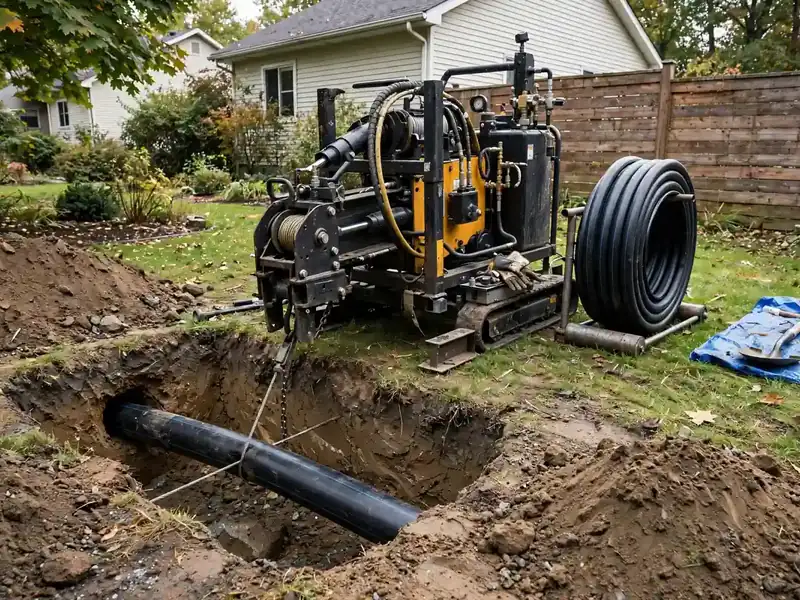
When a sewer line collapses, fills with roots, or simply reaches the end of its material life, the traditional fix is an open trench from the house to the street — which means tearing up lawns, driveways, patios, and landscaping along the way. Pipe bursting takes a different path. Instead of exposing the entire old line, a technician digs two relatively small access pits, feeds a cone-shaped bursting head into the failed pipe, and pulls it through with hydraulic force. The head fractures the old pipe outward into the surrounding soil while a brand-new pipe follows directly behind it, occupying the exact same underground route.
The replacement pipe is high-density polyethylene (HDPE), fused into one continuous length with no joints for roots to exploit. Because the new line follows the old one's path, there is no need to re-route around the house, re-grade the yard, or cut a trench through a concrete driveway. For Southaven homeowners dealing with the area's clay-heavy soils, slab-on-grade foundations, and mature tree cover, that difference matters: the repair happens below the surface while the yard above stays largely intact. If your line has failed and you want to understand whether this trenchless method fits your property, call (833) 713-2101 and you will be connected with an independent local pro who can evaluate the line on site.
The clearest sign is a sewer problem that keeps returning after cleaning. If a line has been cleared of roots or blockages more than once and the backups come back within months, the pipe itself is usually the problem — not what's inside it. A sewer camera inspection often reveals the underlying damage in these cases: sections of clay tile that have cracked and shifted, cast iron eaten through by scale and corrosion, or PVC crushed by soil movement. When the pipe wall itself has failed, no amount of cleaning restores it, and replacement becomes the honest recommendation.
Visible symptoms around the property tell the same story from above ground. Soggy patches or standing water in the yard that never quite dry, a strip of grass that grows faster and greener than the rest of the lawn, sinkholes or depressions forming along the pipe's path, and persistent sewage odors near cleanouts or in the yard all point to a line that is leaking or collapsing underground. In Southaven's shrink-swell clay, these symptoms can appear gradually as seasonal soil movement works old joints apart, then worsen suddenly after a heavy spring thunderstorm surcharges the system.
Pipe material and age complete the picture. Homes built from the 1960s through the 1980s across DeSoto County commonly have clay-tile or cast-iron laterals that are now 40 to 60 years old — well into the window where joints fail, roots enter, and walls collapse. When a camera shows missing pipe sections, severe offsets where one segment has dropped below the next, or a line so choked with roots that the camera cannot pass, spot repairs stop making sense. That is the point where pipe bursting earns its place: instead of patching a pipe that is failing everywhere, the entire run is replaced in one operation.
Every pipe bursting job starts with diagnosis, not digging. Step one is a camera inspection of the full lateral, from the foundation exit to the city tap, so the technician knows the pipe's material, depth, diameter, and the exact location and extent of the damage. Step two is utility locating — every underground utility crossing the pull path (gas, electric, water, communications) is marked before any excavation, and the 811 locate service is part of standard preparation. Step three is planning the pull: the entry pit is placed where the lateral exits the foundation near the house, and the exit pit near the property line or tap, with the run between them mapped for depth and obstacles.
Step four is excavation of the two access pits, typically about four feet square, shored for safety. Step five is the pull itself: a steel cable or rod string is threaded through the old pipe from the exit pit to the entry pit, attached to the bursting head, and the new HDPE pipe — fused into a single continuous length — is connected behind the head. A hydraulic pulling unit at the exit pit draws the whole assembly through. As the head advances, its expander cone fractures the old pipe outward and compacts the fragments into the surrounding soil, while the new pipe slides into the freshly opened path immediately behind it. The pull is monitored continuously for resistance and alignment.
Step six is connection and restoration. The new HDPE line is connected to the home's drain system at the foundation and to the city tap or main at the property line, with proper fittings and verified grade so wastewater flows by gravity. The line is then tested — usually with water flow and a follow-up camera pass — before the pits are backfilled, compacted in lifts, and the surface restored. Compared with an open trench, the disturbed area is limited to the two pits, which is why homeowners with driveways, patios, or mature landscaping over the pipe route so often choose this method. For a detailed walkthrough of the mechanics, see how pipe bursting works in detail.
The centerpiece of the operation is the bursting head — a hardened steel expander, larger in diameter than the old pipe, that fractures brittle materials like clay tile, concrete, and cast iron outward as it advances. It is pulled by a hydraulic bursting unit anchored at the exit pit, with force ratings matched to the pipe diameter, soil conditions, and pull length. A cable or sectional rod string connects the puller to the head, threaded through the existing line before the pull begins. Pneumatic bursting systems, which hammer the head forward, exist for certain soil conditions, but static hydraulic pulling is the common approach for residential laterals because it offers steadier control.
The replacement pipe is HDPE — high-density polyethylene — delivered in sticks or coils and fused on site with a heat-fusion welder that melts the pipe ends together into a single monolithic length. Fusion matters because it eliminates joints entirely: there are no bell-and-spigot connections for roots to pry open and no gaskets to deteriorate. HDPE also flexes slightly under soil load rather than cracking, which suits DeSoto County's clay soils that swell when wet and shrink when dry. After the pull, standard DWV-rated fittings make the transitions at the house and the tap, and a locating wire or tracer tape is typically installed with the new line so it can be found accurately in the future.
Support equipment rounds out the job: a push camera for the pre- and post-pull inspections, a sonde locator to track the camera head's depth and position from the surface, a compact excavator or hand-digging tools for the pits depending on access, trench shoring or a trench box for pit safety, and compaction equipment for backfill. Before any of it arrives, the pro verifies the pipe is a candidate — bursting needs a host pipe the head can travel through, so a line that is fully collapsed into a void with no continuous path may need a different approach, which is exactly what the camera inspection determines.
Underground work carries real risks, and the precautions are non-negotiable. Every buried utility along the pull path must be located and marked before excavation — striking a gas or electric line during pit digging or the pull itself is the single most dangerous failure mode on this kind of job. The access pits, which can run several feet deep depending on the lateral's depth, require proper shoring or sloping so the walls cannot cave in on anyone working in them. Spoil piles are kept back from the pit edge, and the work area is barricaded so nobody walks into an open excavation.
During the pull, the crew keeps the path clear and monitors the hydraulic unit's pressure readings; a sudden spike can indicate an obstruction such as an unmapped utility, a concrete encasement, or a repair clamp from a previous fix, and the correct response is to stop and investigate rather than force through. After the new pipe is in place, the connections at both ends are the critical detail — a poorly graded or poorly sealed transition at the foundation or the tap will cause the same backups the replacement was meant to cure, so the pro verifies grade and runs water and camera checks before backfilling. Homeowners should keep children and pets away from the work area until the pits are filled and compacted.
Southaven's ground conditions shape every pipe bursting job here. Much of DeSoto County sits on loess soils with a meaningful clay fraction that swells when saturated and shrinks during dry spells — that decades-long cycling is what works old pipe joints apart and what makes the outward displacement of bursting effective, since the fragmented old pipe compacts into soil that has already been moving around it for years. The region's 55-plus inches of annual rainfall, concentrated in heavy spring thunderstorms, surcharges older lateral joints and exposes inflow problems, which is why camera inspections here so often find stormwater entering through failed joints alongside the sewage the pipe was meant to carry.
Housing stock varies widely across the city, and the pipe material follows the era. Neighborhoods with 1960s–1980s homes — Carriage Hills, Southcrest, Greenbrook — still hold clay-tile and cast-iron laterals that fragment cleanly under a bursting head, making them natural candidates. Newer subdivisions run PVC, which bursts fine when it has genuinely failed but more often calls for a different fix. Slab-on-grade foundations, standard across the area, mean the lateral exits through or beneath the slab — a spot the camera inspection examines closely, since a shifted joint at the foundation exit changes the entry-pit plan.
Lot layout matters as much as soil. On wooded acre-plus lots like those in Bridgemoore, laterals run long distances under mature trees, and bursting preserves root systems that an open trench would destroy. On zero-lot-line properties like Ross Pointe Farms, fitting an excavator and two pits onto a tenth-acre lot takes planning, and easement lines must be verified before digging. And where a subdivision straddles city boundaries — Robinson Crossing and Williams Ridge touch Southaven, Olive Branch, and Nesbit — confirming which utility owns the main at the tap is part of the pre-job homework. If your line has failed and you want a trenchless replacement evaluated for your specific lot, trenchless repair options start with a camera inspection — call (833) 713-2101 to get connected with a local pro.
For Brentwood Estates' 25-to-30-year-old PVC laterals, pipe bursting offers a trenchless full replacement: the old pipe is broken underground while a new seamle
Read MoreWhen a Bridgemoore lateral fails under the woods, pipe bursting replaces it without clearing trees: a bursting head fractures the old pipe underground while…
Read MoreCarriage Hills' 1960s clay-tile and cast-iron laterals are prime candidates for pipe bursting, which fractures brittle old pipe underground and pulls a new seam
Read MorePipe bursting is rarely needed in Cherry Tree Park's 2006–2021 community — but where construction damage or a destroyed tap has structurally failed a young line
Read MoreDeerchase's compact lots make pipe bursting's small footprint the practical replacement: two pits — entry and exit — while the bursting head fractures the old…
Read MoreOn Dickens Place's estate lots, pipe bursting replaces a failed lateral without trenching through the landscaping: the old pipe fractures underground as new…
Read MoreGreenbrook's 1977–1986 first-generation plastic lines, once past lining's reach, get a trenchless full replacement by pipe bursting: the old pipe is fractured…
Read MoreAt Hidden View's lakeside lots, pipe bursting replaces a structurally failed lateral with planning for the high water table: old pipe fractured underground,…
Read MoreThe Highlands' uniform 2000-era laterals are hitting the tap-failure window together — and pipe bursting replaces a structurally failed one trenchlessly, fractu
Read MoreHuntleigh's 1989-era iron and early plastic, once structurally failed, is pipe-bursting territory: the brittle old pipe fractures underground while a new seamle
Read MoreAt Lakes of Nicholas, pipe bursting is the correction tool for young lines whose settling has defeated their geometry: the misshapen pipe is fractured undergrou
Read MoreOlivers Glen's 20-year joint-shift pattern, once past what lining can bridge, calls for pipe bursting: the old lateral is fractured underground while new seamle
Read MorePinewood's 2022–2024 lines fail by settling, not age — and where a young lateral's geometry is defeated past lining's reach, pipe bursting installs new pipe…
Read MoreThirty years of soil cycling have pushed Plum Point Villages' 1990s joints past sealing — where offsets have gone structural, pipe bursting replaces the run…
Read MoreRasco Farms' 2022–2023 builder-era defects get an honest sequence — warranty first, camera always — and where the footage proves a defect past lesser methods,…
Read MoreIn Robinson Crossing, pipe bursting starts with confirming which utility owns your main on the municipal seam — then replaces the failed lateral trenchlessly,…
Read MoreRoss Pointe Farms' 0.11-acre zero-lot lines make pipe bursting's two-pit footprint the practical full replacement: old pipe fractured underground, new seamless
Read MoreAt Silo Square, pipe bursting handles commercial-grade laterals — grease lines, shared building runs — trenchlessly: old pipe fractured underground, new HDPE…
Read MoreIn the Snowden District, pipe bursting replaces failed commercial laterals on the event calendar's terms: old pipe fractured underground, new HDPE pulled throug
Read MoreSnowden Grove's 2000s laterals, once structurally failed, get a trenchless replacement by pipe bursting: the old pipe fractures underground while new seamless…
Read MoreSouthcrest's 1980s lines are at genuine end of life — and pipe bursting is their trenchless replacement: brittle clay, concrete, and iron fractured underground
Read MoreAt Williams Ridge, pipe bursting starts by confirming which of three possible utilities serves your parcel — then the failed lateral is replaced trenchlessly,…
Read MorePipe bursting replaces the line along its existing underground path using only an entry pit and an exit pit, while traditional replacement opens a continuous trench from the house to the street. The trenchless approach leaves driveways, patios, and landscaping between the pits undisturbed. Both methods end with a brand-new pipe; the difference is how much of your yard gets excavated to install it.
Yes — roots are one of the most common reasons lines get burst. The roots are cut during the cleaning phase so the cable and bursting head can travel the pipe, then the head fragments the old root-damaged pipe outward while the new seamless HDPE pipe takes its place. Because the replacement has no joints, roots lose the entry points they were exploiting in the old line.
Those are the materials pipe bursting handles most naturally. Clay tile, concrete, and cast iron are brittle, so the bursting head fractures them outward into the surrounding soil as it advances. PVC and ABS can also be burst when they have genuinely failed. The camera inspection beforehand confirms the material and rules out conditions — like a fully collapsed void with no continuous path — that would call for a different method.
Only at the two access pits. The bursting head and new pipe stay underground between the two pits — entry at the house, exit at the tap — so anything sitting over the middle of the run — driveways, walkways, gardens, mature trees — stays in place. The pits themselves are backfilled, compacted, and surface-restored when the job is done. If a driveway sits exactly where a pit must go, the pro will discuss that with you before work starts.
HDPE sewer pipe is manufactured for long service life — it does not corrode, scale, or rot, and because it is fused into one continuous length there are no joints to separate or admit roots. Its flexibility also lets it tolerate the soil movement that cracks rigid pipe. Ask the pro doing your job about the pipe manufacturer's documentation so you have the specifics in writing for your property.
The length and depth of the lateral, how accessible the entry and exit points are, the soil conditions, the old pipe's material and diameter, and how many underground utilities cross the pull path. Longer runs, deeper pipe, tight lots, and utility crossings all add complexity. A camera inspection plus a site walk is how a pro scopes the job accurately — call (833) 713-2101 to arrange an on-site evaluation.