Sewer Line Installation in Southaven, MS: The Process Explained
Published: 2026-10-10
Installing a new sewer line — for new construction, an addition, or a full replacement of a failed lateral — is one of the most consequential plumbing projects a property can undergo. Done right, the line works silently for a century. Done wrong, with bad slope or poor bedding, it becomes a chronic source of backups from the day it is buried. Understanding the process helps you vet contractors, understand the timeline, and know what proper work looks like.
This guide walks through each stage of sewer line installation as it happens in the Southaven area: planning and permits, excavation, pipe laying with correct grade, connection and testing, and backfill in our challenging clay soil. If you are planning an installation or a full replacement, call (833) 713-2101 to discuss the project.
Planning, Permits, and Layout
Every legal sewer installation starts with planning and permits. The installer determines the route from the building to the municipal main (or septic system), verifies the connection point and its elevation, and pulls the required permits from the city or county. In Southaven, the connection to the public main typically requires inspection and approval — an unpermitted tap into the municipal sewer is a serious violation, not a shortcut. The plan also includes utility locates: gas, electric, water, and communications lines must be marked before any digging, since striking a gas line turns a plumbing project into an emergency.
The layout must respect setbacks, easements, and existing structures. The route should be as straight as practical — every bend is a future maintenance headache and a place where solids can settle. Depth is determined by frost protection, the main's elevation, and the grade the pipe needs to maintain. In Southaven's flat terrain, achieving proper slope over a long lateral run is the central engineering challenge of the layout: too little slope and solids settle; too much and water outruns the solids, leaving them stranded. The industry standard is a quarter-inch of fall per foot of run, and it is not a suggestion.
Excavation and Bedding
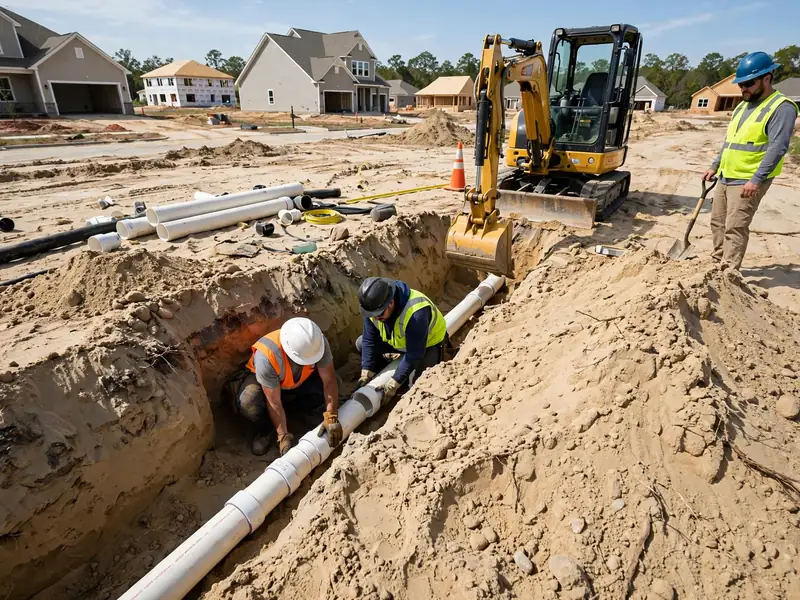
Excavation opens the trench along the planned route. In Southaven's clay soil, trenching has a specific character: clay is stable enough to hold a trench wall, but it is brutal to dig when dry and soupy when saturated after spring rains. Experienced local crews schedule excavation for drier windows and manage trench water with pumps when storms have soaked the ground. The trench must be wide enough for workers and equipment to set pipe properly, with shoring or sloping where depth requires it for safety.
Bedding — the material the pipe rests on — is where installations succeed or fail long-term. The pipe must sit on a uniform bed of compacted granular material (usually sand or fine gravel), never directly on hard clay lumps or rock that create pressure points. In expansive clay, proper bedding and careful compaction around the pipe are what prevent the seasonal heaving from bending or breaking the new line. Skipping or skimping on bedding is the most common cause of premature bellies in new installations: the pipe settles unevenly into poorly prepared soil within a few years. When vetting an installer, ask specifically about bedding material and compaction method — the answer reveals whether they build for decades or for the final inspection.
Pipe Laying, Slope, and Connection
Pipe is laid starting from the lowest point — the connection to the main — and working uphill toward the building, so each joint overlaps correctly in the direction of flow. Modern installations use PVC or HDPE: PVC with gasketed joints for conventional trenching, HDPE with fused joints where trenchless methods are used. Every joint is cleaned, lubricated (for gasketed PVC), and fully seated; a partially seated joint is a future root entry and leak point. The crew checks grade continuously with a laser level or transit — this is not eyeballed. A laser-verified quarter-inch-per-foot fall, consistent along the entire run, is the mark of professional work.
Cleanouts are installed at required intervals and at every major change of direction, giving future maintenance access without excavation. The connection to the municipal main is made with an approved tapping method — often a saddle or a wye fitting — and this connection is typically what the city inspector examines. The building connection ties into the home's drain system with proper transition fittings. Before backfill, the line is tested: usually a water or air test of the sealed line to prove every joint holds, and increasingly a camera inspection to verify grade, joint seating, and the absence of debris. A contractor who resists camera-verifying a brand-new line is telling you something.
Backfill, Compaction, and Restoration in Clay Soil
Backfill is not just pushing dirt back into the trench. The first layer around the pipe — the haunching — is carefully placed granular material compacted by hand or with small tampers to support the pipe's sides without displacing it. Above that, backfill goes in lifts (layers), each mechanically compacted before the next is added. In Southaven clay, this staged compaction is critical: clay dumped loosely into a trench will settle for years, creating a sunken scar across the yard and potentially dragging the pipe down with it.
The final grade should shed surface water away from the trench line, and restoration — sod, concrete, or asphalt — should match what was removed. Expect the disturbed strip to settle somewhat over the first year even with good compaction; a reputable installer returns to top-dress settling areas. The whole project, for a typical residential lateral, usually spans several days: permits and locates, excavation and laying, inspection, backfill, and restoration. Weather is the wildcard — a week of spring storms can pause a project, which is another reason Southaven installations are often scheduled for drier months. For a properly planned sewer line installation with correct grade, bedding, and compaction, call (833) 713-2101.
Frequently Asked Questions
How deep is a residential sewer line buried?
Typically 2 to 6 feet deep for residential laterals, depending on the municipal main's depth, frost protection needs, and the slope required over the run's length. Deeper is not better — depth follows the engineering: enough cover to protect the pipe, with the grade maintained from house to main. Your installer determines depth from the main's elevation at the connection point.
How long does a sewer line installation take?
A typical residential lateral installation takes several days: utility locates and permits, a day or more of excavation and pipe laying, inspection, then backfill and restoration. Commercial or unusually long, deep, or obstructed runs take longer. Weather is the main variable in Southaven — saturated spring soil can pause excavation, so dry-season scheduling keeps projects on track.
What pipe material is used for new sewer lines?
PVC is the standard for conventionally trenched residential sewer lines — durable, root-resistant at its gasketed joints, and rated for a century of service. HDPE with fused, jointless connections is used for trenchless installations. Both far outperform the clay and cast iron they replace. Your installer should explain the material choice for your specific project.
Do I need a permit to replace my sewer line?
Yes — sewer line replacement and new installation require permits, and the connection to the municipal main requires inspection and approval. Unpermitted sewer work can result in fines, forced removal, and major problems when you sell the home. A legitimate contractor handles the permit process as part of the project; if a contractor suggests skipping permits, find a different contractor.
Will installation destroy my landscaping?
Conventional trenching disturbs a strip along the pipe's route — there is no way around that — but a careful crew minimizes the footprint, protects what can be protected, and restores the surface afterward. Where the route crosses irreplaceable landscaping, driveways, or structures, trenchless methods like pipe bursting can replace the line with only small access pits. Discuss the route and restoration plan before work begins.