Sewer Line Repair vs. Replacement in Southaven, MS: How to Decide
Published: 2026-10-10
When a sewer line fails, the question is rarely whether to act — it is how far to go. A targeted repair fixes the damaged section and leaves the rest. A full replacement renews the entire line from house to main. Both can be the right answer, and choosing wrong is expensive in either direction: repairing a line that is failing everywhere, or replacing a line that needed one fix.
This guide gives you the decision framework professionals use: the condition of the pipe, its age and material, the pattern of failures, and your long-term plans for the property. The starting point for any decision is seeing the line's actual condition with a sewer camera inspection — call (833) 713-2101 to get the footage your decision should be based on.
When Targeted Repair Is the Right Call
Repair makes sense when the damage is localized and the rest of the line is sound. The classic cases: a single cracked joint, one offset segment, an isolated root intrusion at one connection, or a short section damaged by construction. If the camera shows 50 feet of healthy pipe and one bad spot, replacing the whole line means paying to renew pipe that has decades of life left — a targeted repair, possibly trenchless, is the proportionate response.
Repair is also the right call when the pipe material still has substantial life. A 25-year-old PVC line with one damaged section is a repair candidate; its material is barely middle-aged. Budget and timing factor in too: a well-executed repair buys years of reliable service, which matters if you plan to sell the home soon or need to spread major expenses over time. The key condition is that the camera supports the decision — the undamaged sections should actually look undamaged, with good joints, no bellies, and no widespread root entry. A repair decision made without footage is a gamble, not a strategy.
When Replacement Is the Honest Answer
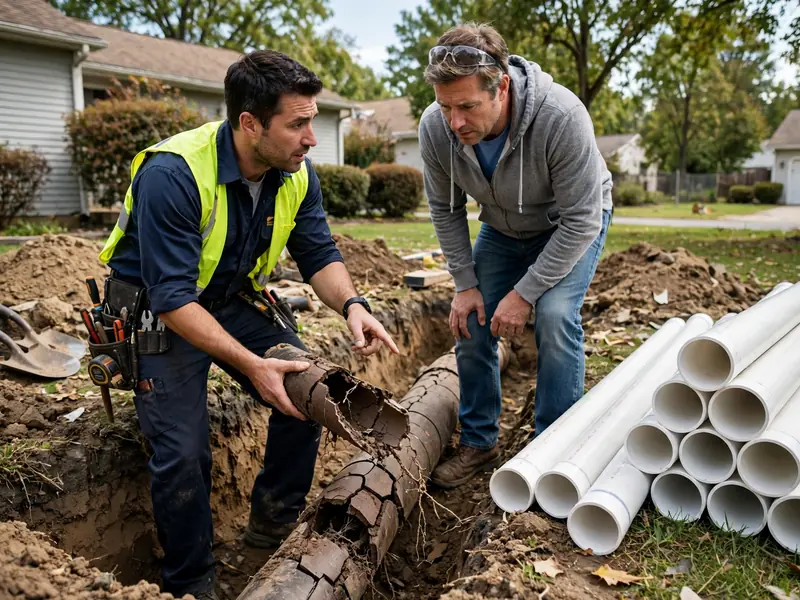
Replacement is the answer when the camera shows systemic failure: multiple cracked or offset joints along the run, widespread root intrusion at every seam, several bellies, or a line that is essentially a series of patches. At that point, repairing one section just moves the next failure to the adjacent joint — homeowners in this cycle recognize the pattern of annual emergency visits, each fixing a different spot on the same dying line.
Age and material push the same direction. A 60-year-old clay line with joint failures, a cast iron line with advanced internal corrosion, or any Orangeburg line that has begun to deform are all at or past their functional lives; repairing them is temporary by definition. Frequency of problems is the practical test: if the line has needed professional intervention more than once in two years, the economics flip — the cumulative cost of repeated repairs, emergency visits, and water damage quickly exceeds a single replacement. And if you plan to stay in the home long-term, replacement converts an unpredictable liability into a new, warrantied asset. A new HDPE or PVC line should outlast your ownership of the home.
The Middle Ground: Trenchless Rehabilitation
Many Southaven homeowners face a line that is too deteriorated for spot repair but does not obviously demand full excavation — and that is where trenchless rehabilitation earns its place. Pipe lining creates a new jointless pipe inside the old one, effectively renewing the full run without replacing it: ideal for lines with widespread joint failure, root intrusion, and cracking where the pipe still holds its shape. It is replacement of function without replacement of the pipe itself.
Pipe bursting goes further, physically replacing the old pipe with new HDPE while still avoiding an open trench — the choice when the old line is collapsed, deformed, or undersized. Both methods renew the entire run, which resolves the whack-a-mole problem of spot repairs on a failing line, and both preserve landscaping and hardscaping that excavation would destroy. The deciding factor between trenchless rehabilitation and conventional excavation is usually the pipe's shape (lining needs an intact host pipe; bursting needs displaceable soil and utility clearance) and what sits above the line. Your contractor should present all viable options with the camera footage in front of you — not just the one method they happen to offer.
A Decision Checklist for Southaven Homeowners
Work through these questions with your camera footage in hand. One: how many defects are there, and are they clustered or spread along the run? Clustered favors repair; spread favors replacement. Two: what is the pipe material and approximate age — is this a young line with an injury or an old line with a condition? Three: what is the failure pattern — first problem ever, or the third visit in two years? Four: what does the soil and setting allow — will excavation destroy a new driveway or mature trees, making trenchless strongly preferable? Five: what are your plans — selling next year argues for the proportionate fix; staying for decades argues for the permanent one.
Then get it in writing: the diagnosis with footage markers, the recommended option with reasons, the alternatives considered and why they were rejected, and warranty terms for each option. Be skeptical of anyone who recommends full replacement for a single defect without showing you why, and equally skeptical of anyone who proposes a third spot repair on a line the camera shows is failing everywhere. The right decision is the one the footage supports. For an honest, camera-based assessment of whether your line needs repair or replacement, call (833) 713-2101.
Frequently Asked Questions
Can a sewer line be repaired without digging?
Often, yes. Trenchless methods handle most scenarios: pipe lining renews the inside of a damaged-but-intact line through small access points, and pipe bursting replaces the line entirely with only entry and exit pits. Spot repairs can sometimes be done through a single small excavation. Full open-trench replacement is reserved for collapsed lines, severe bellies, or situations where trenchless methods do not apply.
How do I know if my whole line needs replacement?
The camera inspection is decisive. Systemic failure — multiple bad joints, widespread roots, several bellies, advanced corrosion along the run — means replacement. So does a pattern of recurring failures at different spots, or a pipe material at the end of its life (Orangeburg, badly corroded cast iron, joint-failed clay). A single defect in an otherwise sound line means repair. There is no shortcut around looking at the footage.
Is pipe lining as good as a new pipe?
For the right candidate line, effectively yes. A cured CIPP liner is a structural, jointless new pipe inside the old one, with a decades-long design life and better flow characteristics than the clay or cast iron it renews. It cannot fix collapsed sections, severe bellies, or wrong slope — those need bursting or excavation. The camera inspection determines whether your line is a lining candidate.
Should I replace the sewer line before selling my house?
It depends on condition and market. A documented new or rehabilitated line is a selling point, especially in Southaven's older neighborhoods where buyers worry about clay laterals. But if the line is sound, a recent camera inspection showing good condition may satisfy buyers without the expense. If the line is failing, disclose honestly — a pre-listing inspection lets you control the narrative instead of losing the sale to the buyer's inspection.
What warranty should I expect on replacement vs. repair?
Full replacements and trenchless rehabilitations typically carry multi-year warranties on materials and workmanship — get the terms, duration, and exclusions in writing. Spot repairs carry shorter warranties limited to the repaired section, which is appropriate since the rest of the old line remains. Compare warranty terms alongside the quotes; a longer warranty on a complete renewal is part of what you are paying for.