Sewer Pipe Materials: The Complete Guide for Southaven, MS
Published: 2026-10-10
What your sewer line is made of determines how it fails, how long it lasts, and which repairs are possible. Southaven's housing stock spans the full history of sewer pipe materials — from mid-century clay and cast iron in the oldest subdivisions to modern PVC and HDPE in new construction — so the material under your yard depends largely on when your home was built.
This guide covers every common sewer pipe material: what it is, when it was used, its strengths and weaknesses, and how it behaves in Southaven's clay soil. If you do not know what is buried under your yard, a sewer camera inspection will identify it — call (833) 713-2101.
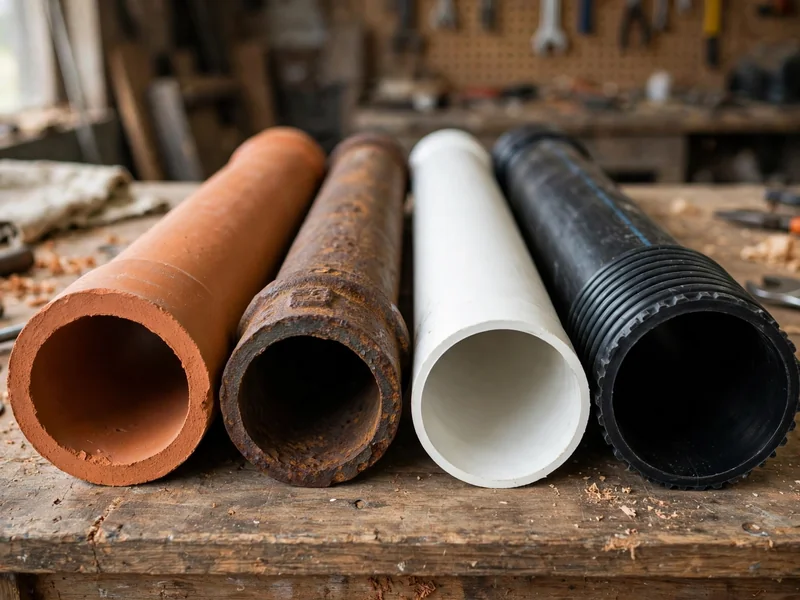
Clay, Cast Iron, and Orangeburg: The Older Materials
Vitrified clay pipe — sections of fired clay joined every few feet — was the residential standard through the mid-20th century and remains under many Southaven homes built before 1980. The clay itself is nearly indestructible; the joints are the failure point. Each joint is a seam that Southaven's shifting clay soil works apart and that tree roots penetrate. Clay lines fail at the joints long before the pipe material gives out, which is why root intrusion and offset segments are the signature clay problems.
Cast iron was widely used from the 1950s through the 1970s, often for the building sewer transition. It is enormously strong but corrodes from the inside: wastewater and soil chemistry eat the pipe from within, building up rust scale that narrows the bore and eventually perforating the bottom. A cast iron line can look fine from outside while being paper-thin inside — the camera reveals the truth. Orangeburg, a tar-impregnated wood-fiber pipe used roughly 1945–1975, is the problem child: it softens with age, deforms under soil pressure into an oval, and eventually collapses. Any Southaven home from that era still on its original Orangeburg line is living on borrowed time; replacement, not repair, is the conversation.
PVC and ABS: The Modern Standards
PVC (polyvinyl chloride) has been the residential standard since the 1980s, and for good reason. It does not corrode, it does not scale, its gasketed joints resist root entry far better than clay's mortar joints, and it is rated for a century of service. Nearly every Southaven home built after 1990 — including entire newer subdivisions like Silo Square — runs on PVC laterals, which is why sewer failures in those neighborhoods are rare and usually trace to construction damage or misuse rather than material aging.
ABS (acrylonitrile butadiene styrene), the black plastic pipe, is PVC's close cousin — similar longevity and corrosion resistance, joined with solvent-welded connections. It was more common in some regions and eras than others; performance is comparable to PVC. Both plastics share one vulnerability: they are only as good as their installation. Poor bedding in shifting clay, inadequate compaction, or bad slope will make even PVC fail early — the material is excellent, but it cannot compensate for a trench that was not built right. That is why new installations should always be camera-verified before backfill.
HDPE and Cured-in-Place Liners: The Trenchless Materials
HDPE (high-density polyethylene) is the pipe of trenchless replacement. Installed by pipe bursting, it is fused into one continuous, jointless run — no seams anywhere for roots to exploit — and it flexes slightly with soil movement instead of cracking like rigid pipe. That flexibility is a genuine advantage in Southaven's expansive clay: where clay pipe joints separate under heaving, HDPE rides the movement. Its projected service life rivals or exceeds PVC.
Cured-in-place (CIPP) liners are the other trenchless material: a resin-saturated sleeve that hardens inside the existing pipe into a structural, jointless new pipe-within-a-pipe. The cured resin — typically epoxy — is corrosion-proof and root-resistant, with a design life measured in decades. The liner's limitation is that it follows the host pipe's shape, so it inherits any bellies or bad slope. Together, HDPE and CIPP mean that a Southaven homeowner with a failed clay or Orangeburg line never needs to install those obsolete materials again — the replacement is always a modern, jointless system.
What Southaven Homeowners Should Take Away
First, know your material: pre-1980 homes likely have clay, cast iron, or Orangeburg; post-1990 homes almost certainly have PVC. Your home's age is a reliable first guess, and a camera inspection confirms it. Second, match your maintenance to the material: clay lines need root vigilance and joint monitoring; cast iron needs scale awareness and corrosion checks; PVC needs little beyond keeping grease and wipes out. Third, let material guide repair decisions: spot-repairing Orangeburg is throwing money at a material that is failing everywhere, while spot-repairing young PVC is perfectly sensible.
Fourth, understand the soil interaction. Southaven's clay is hardest on rigid, jointed materials — every seasonal swell-shrink cycle works clay joints apart and stresses cast iron. Flexible, jointless replacements (HDPE, CIPP) are engineered around exactly this weakness, which is why trenchless rehabilitation performs so well here. Finally, never replace old pipe with old technology: any replacement today should be PVC, HDPE, or CIPP — materials that will still be sound when the next generation owns the home. For a camera inspection that identifies your pipe material and its condition, call (833) 713-2101.
Frequently Asked Questions
How can I tell what material my sewer line is?
Your home's age is the most reliable clue: before 1980, likely clay, cast iron, or Orangeburg; after 1990, almost certainly PVC or ABS. A camera inspection identifies the material definitively — the technician can see and recognize each type — and also shows its condition. If you are buying an older Southaven home, make material identification part of the pre-purchase inspection.
Is Orangeburg pipe really that bad?
Yes. Orangeburg was a wartime and post-war substitute material — essentially tar-soaked fiber — that deforms under soil pressure and has a functional life of roughly 30 to 50 years. Every Orangeburg line still in service is past or approaching failure. If your home has it, plan for replacement proactively rather than waiting for the collapse, which always happens at the worst time.
Can clay pipe be repaired, or must it be replaced?
It depends on the extent of joint failure. Isolated cracked joints or a single offset can be spot-repaired or lined. But when the camera shows failed joints along the whole run — the typical end-of-life clay pattern in Southaven's shifting soil — lining or full replacement is the durable answer. Clay's material is fine; it is the joints that doom it, and a jointless rehabilitation solves the joint problem permanently.
Is PVC really better than cast iron?
For sewer laterals, yes, in the ways that matter: PVC does not corrode, does not build up internal scale, and its joints resist root intrusion far better than clay or cast iron joints. Cast iron's advantage was raw strength, but strength does not help against internal corrosion — the failure mode that actually kills cast iron lines. Modern PVC and HDPE outperform all the older materials for longevity.
What material should a replacement line use?
PVC for conventional trenching, HDPE for pipe bursting installations, or a CIPP liner for trenchless rehabilitation — all jointless or near-jointless modern materials rated for many decades. Never accept a replacement in clay, cast iron, or Orangeburg; those materials are obsolete for good reason. Your contractor should specify the material in the written quote.