Tree Roots in Sewer Lines: A Southaven, MS Homeowner's Guide
Published: 2026-10-10
Southaven's mature tree canopy is one of the area's finest features — and one of the leading causes of sewer line failure. Tree roots seek moisture relentlessly, and a sewer line is a year-round underground water source. A root hair slipping through a tiny joint gap this spring can become a pipe-splitting woody mass within a few seasons. In neighborhoods with large oaks and mature landscaping, root intrusion is not a freak occurrence; it is the expected lifecycle of an aging clay line.
This guide explains why roots target sewer lines, how the damage progresses, how professionals remove roots, and — most importantly — how to prevent the cycle from repeating. If your drains are slowing and large trees stand near your line, call (833) 713-2101 for a camera inspection to see what the roots are doing down there.
Why Roots Invade Sewer Lines
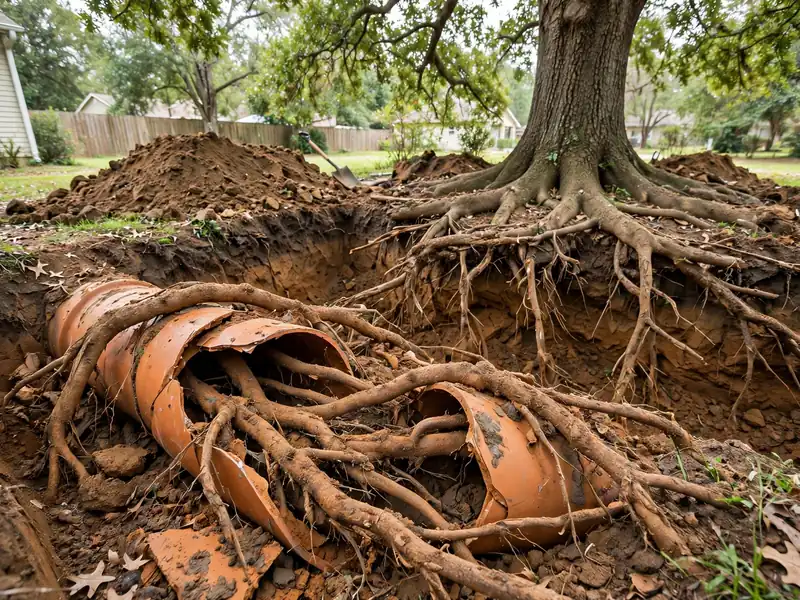
Roots do not punch through sound pipe — they exploit existing openings. Every joint in a clay or cast iron line is a potential entry: mortar joints in clay pipe crack and separate as Southaven's expansive soil heaves, creating gaps as small as a millimeter. Inside the pipe, warm, nutrient-rich wastewater flows constantly. Root tips detect the moisture vapor escaping through those gaps and grow toward it with remarkable precision. Once a hair-fine root enters, the feast begins.
Inside the pipe, the root finds ideal growing conditions: constant moisture, warmth, and nutrients. It branches and thickens, and as it grows, it wedges the joint further apart — which admits more roots. This positive feedback loop is why root intrusion accelerates: the first year shows fine hairs, the second shows a fibrous mat, and by the third or fourth year the mass can fill the pipe bore and crack the surrounding segments. PVC and HDPE lines with fused or gasketed joints resist this dramatically better — roots cannot enter where there are no gaps — which is why root problems in Southaven concentrate in pre-1990 clay and cast iron lines.
Southaven's Trees, Soil, and the Root Calendar
The local tree palette matters. Southaven's mature neighborhoods — Cherry Tree Park, Deerchase, Greenbrook, and similar established subdivisions — feature large oaks, maples, pines, and sweetgums with extensive root systems that can extend two to three times the canopy's diameter. A 40-foot oak 25 feet from your sewer line is well within root range. Fast-growing, water-hungry species are the most aggressive, but any large tree near an aging jointed line is a candidate intruder.
Southaven's clay soil intensifies the cycle in two ways. First, seasonal heaving opens pipe joints wider each year, creating fresh entry points. Second, clay holds water near the surface in wet seasons and bakes hard in summer drought — during dry spells, the sewer line becomes the most reliable moisture source around, and root growth toward it accelerates. Spring is peak intrusion season: trees push new root growth just as spring rains keep soil workable. Homeowners with a root history should think of root management as seasonal maintenance, like gutter cleaning — the roots will come back, so the schedule must be permanent until the entry joints are sealed.
Removal: Cutting, Jetting, and What Each Achieves
Professional tree root removal starts with the camera: the technician locates each intrusion, assesses the pipe's structural condition, and chooses the method. Mechanical cutting feeds a rotating root-cutting head through the line, shredding the mass. It is fast and effective for heavy blockages, but it leaves cuttings behind and does nothing for fine root hairs embedded in joint gaps. Hydro jetting with root-cutting nozzles follows or substitutes: high-pressure water pulverizes the mass and flushes everything — cuttings, hairs, sludge — out of the line, leaving the pipe genuinely clean.
Both methods share a critical limitation: they remove the roots, not the entry points. The cracked joints remain open, and roots regrow — typically within 12 to 24 months in Southaven's vigorous growing conditions. Chemical root treatments (copper sulfate or foaming agents) applied after mechanical removal can slow regrowth by poisoning the root tips at the pipe wall, buying extra months between cleanings. But no chemical seals a cracked joint. Removal without repair is maintenance, not a cure — necessary, valuable maintenance that keeps the line flowing, but maintenance that must be repeated until the pipe itself is fixed.
The Permanent Fix: Sealing Roots Out
The only permanent answer to root intrusion is eliminating the entry points. Pipe lining is the ideal root solution for lines that are otherwise intact: the cured liner creates a seamless, jointless new pipe inside the old one, and roots cannot penetrate a surface with no seams. For Southaven's clay lines with root intrusion at every joint — the classic pattern — lining converts a root-magnet into a root-proof line in a day, without disturbing the trees or landscaping above.
When the line is too deteriorated to line — collapsed sections, severe offsets, deformed pipe — pipe bursting replaces it with jointless HDPE, equally root-proof. Either way, the new pipe breaks the cycle permanently. Prevention for the rest of the yard: when planting, keep trees at least as far from the line as their mature canopy spread; choose less aggressive species near utilities; and never plant directly over the sewer easement. If you love your mature trees — and most Southaven homeowners do — trenchless rehabilitation is the way to keep both the trees and a functioning sewer: the roots stay, the entry points disappear, and the conflict ends. Call (833) 713-2101 to discuss root removal and permanent repair options.
Frequently Asked Questions
How do I know if tree roots are in my sewer line?
The telltale signs: drains that slow progressively over months, backups that recur after clearing, gurgling fixtures, and symptoms that worsen in spring during peak root growth. If large trees stand near your line's route, roots are a prime suspect. A camera inspection confirms it definitively — you will see the root masses on video — and shows whether the pipe is structurally damaged or just intruded.
Will cutting roots damage my pipes?
Professional root cutting is designed for the pipe material and condition — but it is a real consideration on badly deteriorated lines. An aggressive cutter in a crumbling Orangeburg or badly cracked clay line can break through weakened walls. That is why the camera inspection comes first: it shows whether the pipe can withstand mechanical clearing or needs a gentler approach followed by repair. Never let anyone cut roots blind in an old line.
Do chemical root killers work?
As a maintenance aid between professional cleanings, yes — copper sulfate and foaming root treatments kill root tips at the pipe wall and slow regrowth. As a cure, no — they cannot seal the cracked joints roots enter through, and they will not clear an established woody mass. Think of them as buying time, not solving the problem. They also should not be used as a substitute for removing a blocking mass.
Should I remove the tree causing the problem?
Usually not necessary — and often not the real fix. Removing the tree stops new root growth eventually, but the cracked joints remain, and other roots or soil movement will exploit them. The durable solution is sealing the entries with lining or replacing the line with jointless pipe; then the tree and the sewer coexist. Remove a tree only if it is directly damaging structures or if its removal is part of a planned excavation repair.
How often do roots grow back after removal?
In Southaven's growing conditions, expect noticeable regrowth within 12 to 24 months after cutting or jetting if the entry joints remain open — faster for aggressive species in wet years. That is why root-prone lines need maintenance on a schedule, not as a one-time event. The schedule ends only when the entries are sealed by lining or the line is replaced with jointless pipe.