Trenchless Sewer Repair Limitations: A Southaven, MS Reality Check
Published: 2026-10-10
Trenchless sewer repair — pipe lining and pipe bursting — has earned its popularity honestly: it fixes lines without tearing up yards, driveways, and landscaping. But trenchless is not magic, and it is not universal. Every trenchless method has physical requirements, and lines that do not meet them need conventional excavation. Knowing the limitations protects you from paying for a trenchless repair that cannot work — or from a contractor who sells trenchless for every situation because it is all they offer.
This guide covers the real limitations of both lining and bursting, the site conditions that rule them out, and how to make sure the method matches your line. The arbiter in every case is the camera inspection: call (833) 713-2101 and make sure any trenchless recommendation starts with footage.
When Pipe Lining Cannot Work
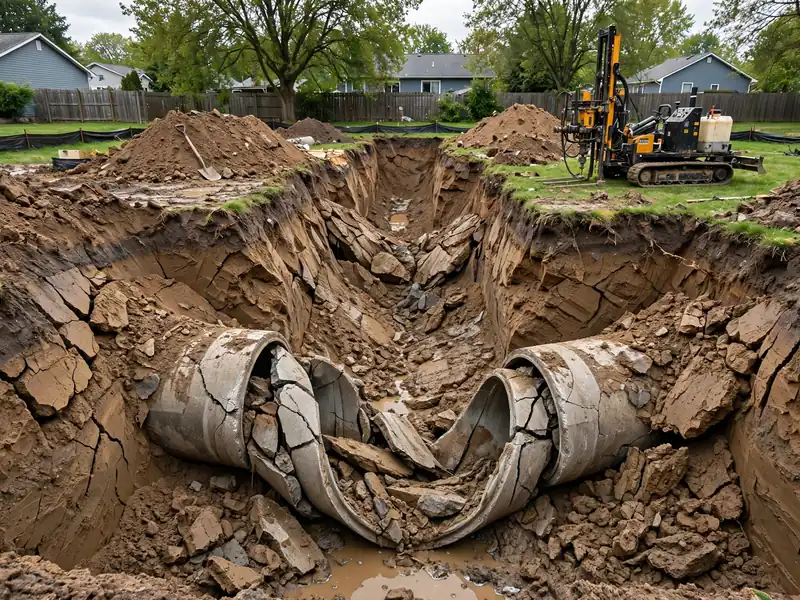
Lining builds a new pipe inside the old one — so it needs an old pipe with enough structural integrity to serve as a form. A fully collapsed section is the hard stop: there is no pipe left to line, and the liner cannot bridge a gap where the host has caved in. Severely deformed pipe (such as collapsed Orangeburg) is equally disqualifying — the liner would cure into a deformed shape with restricted flow. These are the most common reasons Southaven's oldest lines fail lining candidacy.
Bellies and bad slope are the subtler disqualifiers. A liner follows the host pipe's exact shape, so a sagging section that holds standing water becomes a lined sagging section that still holds standing water — the symptom persists inside a brand-new liner. Likewise, a line installed with the wrong pitch drains wrong whether it is lined or not; lining cannot correct grade. Significant offset joints — where one segment has shifted sideways from the next — can also block the liner's passage or leave a step the liner cannot smooth. The camera inspection measures all of this; a lining proposal without footage showing a viable host pipe is a proposal you should not accept.
When Pipe Bursting Cannot Work
Pipe bursting fractures the old pipe outward and pulls a new one through — so it needs soil that can accept the displacement and a path free of immovable obstructions. The hard stops: a pipe encased in concrete (common where lines pass under slabs or were repaired with concrete encasement), large rocks or rubble in the soil that the bursting head cannot displace, and proximity to other utilities that the outward bursting forces could damage. In Southaven's established neighborhoods, crowded utility corridors under streets and driveways sometimes rule bursting out for the section near the main.
Shallow pipe is another limitation: bursting needs enough soil cover above the pipe to contain the displacement forces — too shallow, and the ground heaves instead of the pipe fracturing cleanly. Repaired sections with mismatched materials or previous patch repairs can also complicate the pull, as the bursting head meets varying resistance. And like lining, bursting does not fix bad soil: if the original belly was caused by settled, uncompacted fill, the new pipe needs proper bedding and compaction during installation or it will develop the same sag. Bursting replaces the pipe, not the ground it sits in.
Site and Access Constraints
Both trenchless methods need access, and access is not always available. Lining needs an entry point — usually a cleanout — large enough and well-positioned to feed the liner through; a line with no cleanout and no accessible entry may need an excavation just to create access, eroding the trenchless advantage. Bursting needs entry and exit pits, which need space for equipment: a fully built-out lot with no equipment access to the line's endpoints can make pit excavation impractical or destructive enough to defeat the purpose.
Extremely long runs, sharp bends, and multiple diameter changes complicate both methods — liners and bursting assemblies navigate gentle curves, not plumbing obstacle courses. Diameter matters too: lining slightly reduces the inside bore, which is negligible in a 6-inch line but worth calculating in a small-diameter line already at minimum capacity. And groundwater is a practical constraint for lining in particular: a line running full of infiltrating groundwater during Southaven's wet spring can interfere with resin curing, which is why lining is often scheduled for drier months. None of these are flaws in the methods — they are engineering constraints, and a competent contractor identifies them during planning, not during installation.
How to Make Sure Trenchless Is Right for Your Line
The process is straightforward: camera inspection first, method second. The footage should show a lining candidate as a continuous pipe with cracks, root intrusion, or corrosion but no collapse, no severe belly, and acceptable grade — or a bursting candidate as a replaceable run with displaceable soil, adequate cover, and clear utility separation. Ask the contractor to walk you through the footage and point to the specific features that qualify your line for the proposed method. Vague assurances are not a substitute for visible evidence.
Get the limitations in writing: what the contractor verified (utility locates completed, depth and cover confirmed, host pipe condition documented) and what happens if conditions underground differ from the plan. Be cautious of one-method contractors — a company that only does lining will find that every line is a lining candidate, and a bursting-only outfit sees bursting everywhere. The honest assessment sometimes concludes that conventional excavation is the right answer: for collapsed lines, severe bellies, wrong slope, or impossible access, a trench is not a failure of imagination — it is the correct engineering. A candid trenchless sewer repair specialist will tell you when digging is the honest answer. A contractor who recommends digging when trenchless would be easier to sell is usually the contractor telling the truth. For a candid, camera-based assessment of which methods your line qualifies for, call (833) 713-2101.
Frequently Asked Questions
Can trenchless repair fix a collapsed sewer line?
Pipe lining cannot — it needs an intact host pipe to form against. Pipe bursting can replace a collapsed line in many cases, since it fractures the old pipe outward rather than relying on its shape — provided the soil is displaceable, cover is adequate, and utilities are clear. A fully collapsed line with bad soil conditions or utility conflicts may still need conventional excavation. The camera inspection determines which category your collapse falls into.
Does trenchless work on Orangeburg pipe?
Sometimes, with caveats. If the Orangeburg is deformed or collapsed — its typical end state — lining is out, but bursting can often replace it since the soft material fractures easily. If the Orangeburg is still round and intact (unusual but possible), lining may work. Because Orangeburg's condition varies so much, the camera inspection is especially decisive for these lines.
Will trenchless repair fix a belly in my line?
No — and this is one of the most important limitations to understand. Lining copies the host pipe's shape, so a lined belly still holds water. Bursting can correct a belly only if the new pipe is installed with proper grade and bedding; the method itself does not automatically fix the soil settlement that caused the sag. Bellies caused by settled soil need excavation, proper bedding, and compaction to truly resolve.
Can tree roots prevent trenchless repair?
Roots alone do not disqualify trenchless — they are cut out during preparation, and lining then seals the entries permanently. What disqualifies is structural damage the roots caused: cracked-through segments, collapsed sections, or offsets too severe for the liner to navigate. The camera shows whether you have a root problem (trenchless-friendly) or a root-destroyed pipe (possibly not).
Is conventional digging ever better than trenchless?
Yes, in the right circumstances: collapsed or missing pipe sections, severe bellies needing regrading, wrong-slope lines, concrete-encased pipe, impossible trenchless access, or very short shallow repairs under open lawn where a small excavation is simply the most direct fix. Trenchless is a set of tools, not a religion — the right method is the one your line's condition and setting actually support.