Trenchless vs. Traditional Sewer Repair in Southaven, MS
Published: 2026-10-10
When a sewer line needs major work, Southaven homeowners face a fundamental choice: trenchless repair, which fixes the line through small access points, or traditional repair, which excavates a trench along the pipe. Both are legitimate. Both have produced excellent results for decades. The right choice depends on your pipe's condition, what sits above it, your soil, and your priorities — not on which method is trendier.
This guide compares the two approaches honestly across the dimensions that matter: disruption, timeline, suitability for different damage types, longevity, and how Southaven's clay soil and mature neighborhoods tilt the decision. If you are weighing the options for your line, start with a camera inspection — call (833) 713-2101 — because the footage narrows the choice before anything else.
How Each Approach Works
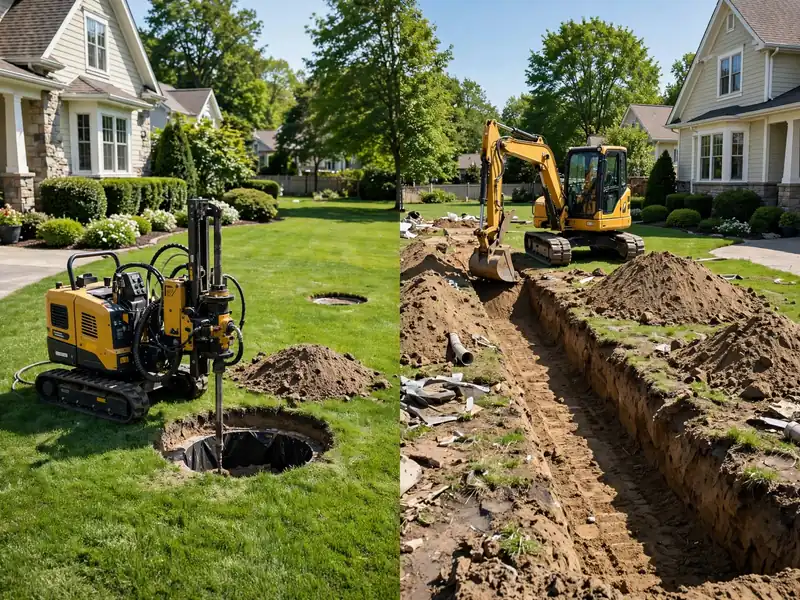
Traditional sewer repair is open-trench excavation: heavy equipment digs along the pipe's route, the damaged section (or the entire line) is removed and replaced with new pipe, the trench is backfilled in compacted lifts, and the surface is restored. It is direct, visual, and complete — the crew sees everything, replaces exactly what is bad, and controls bedding, slope, and compaction directly. For collapsed lines, severe bellies, and wrong-grade pipe, it is the definitive fix because it rebuilds the line and its foundation together.
Trenchless repair comprises two main methods. Pipe lining (CIPP) inserts a resin-saturated sleeve into the existing pipe and cures it into a jointless new pipe-within-a-pipe — no trench, just small access points. Pipe bursting pulls a bursting head through the old line, fracturing it outward, while drawing a new jointless HDPE pipe in behind — two small pits instead of a trench. Both preserve what is above the line: lawns, driveways, patios, and mature trees. Both produce a jointless final pipe that resists roots and soil movement better than the jointed pipe they replace.
Disruption, Timeline, and Restoration
Disruption is trenchless's decisive advantage. A traditional replacement tears up everything above the pipe's route — and in Southaven's established neighborhoods, that route commonly crosses lawns, landscaping, driveways, and walkways. Restoration is a genuine project phase: repaving, re-sodding, rebuilding. Mature trees over the trench line may not survive root-zone excavation. For homeowners with new driveways, pools, or prized landscaping, the restoration cost and heartbreak often exceed the pipe work itself.
Trenchless typically completes faster — most residential jobs in a day or two — with the yard showing only small access patches. But traditional repair is not always the slower, messier choice it is caricatured as: a short, shallow repair under open lawn can be excavated, fixed, and restored efficiently, sometimes more directly than mobilizing trenchless equipment. And traditional repair's visibility is a real asset: the crew verifies bedding, slope, and every joint with their own eyes, while trenchless quality is verified by camera — excellent, but indirect. Honest comparison weighs the whole project, restoration included, not just the pipe work.
Which Damage Each Approach Handles
Match the damage to the method. Lining excels at: cracked pipe, joint failure, root intrusion, corrosion — damage where the pipe's shape survives. Bursting excels at: collapsed sections, deformed pipe, undersized lines needing upsizing. Traditional excavation excels at: severe bellies requiring regrading, wrong-slope lines, concrete-encased pipe, collapsed lines where trenchless access is impossible, and situations where the soil itself must be corrected with new bedding and compaction.
Southaven's clay soil influences the choice in both directions. The soil's seasonal heaving is what destroys jointed clay and cast iron lines — and jointless trenchless results (CIPP liners, HDPE) are engineered specifically to be immune to joint failure, making them excellent long-term answers here. But the same clay makes traditional excavation demanding: heavy digging, careful bedding, and staged compaction are non-negotiable, and wet-spring trenching is miserable. An inexperienced excavator in clay produces the bellies of tomorrow. Whichever method you choose, the contractor's familiarity with local soil matters as much as the method itself.
Making the Decision for Your Line
Work the decision in order. First, the camera footage: it disqualifies options — collapse rules out lining, bad slope rules out lining, utility conflicts can rule out bursting, and a sound line with one defect may need only a spot repair by either method. Second, what is above the line: irreplaceable landscaping, new hardscaping, or structures argue powerfully for trenchless; open lawn keeps traditional competitive. Third, the soil and season: clay demands expert bedding either way, and wet-season scheduling favors methods with less open excavation.
Fourth, the long view: both approaches, done properly with modern materials, deliver decades of service — this is not a choice between a real fix and a compromise. Lining and bursting are permanent repairs, not patches, when applied to qualifying lines. Finally, get both options quoted when both are viable: a contractor offering only one method cannot give you a comparison, only a sales pitch. Ask each bidder why their method fits your footage, what the restoration includes, and what the warranty covers. The right answer is the one the camera, the site, and the complete project scope support together. For a camera-based comparison of trenchless and traditional options for your Southaven line, call (833) 713-2101.
Frequently Asked Questions
Is trenchless sewer repair as durable as traditional replacement?
Yes, when applied to a qualifying line. Cured-in-place liners are structural pipes with multi-decade design lives, and HDPE installed by bursting is rated comparably to new PVC. Durability depends on correct method selection and quality installation — a lined collapsed pipe fails, but so does a traditionally installed line with bad bedding. The method matters less than whether it suits the damage.
Which is faster: trenchless or traditional?
Trenchless is usually faster for full-line rehabilitation — typically a day or two for residential work, with minimal restoration afterward. Traditional excavation takes longer overall once digging, backfill, compaction, and surface restoration are counted. For a short, shallow spot repair under open lawn, traditional can be comparably quick. Timelines should be in writing before you decide.
Can I stay in my home during the repair?
Usually yes for both methods. The main constraint is the no-water-use window while the line is disconnected or curing — typically hours for lining, up to a day or more for replacement projects. Your contractor should specify the window in advance. Neither method requires moving out; plan water use around the work schedule.
Does trenchless work under driveways and patios?
That is one of its strongest applications. Lining needs only small access points and bursting needs just entry and exit pits, so driveways, patios, and walkways above the line stay intact — no demolition, no repaving. When the damaged section lies under expensive hardscaping, trenchless often wins the comparison on the total project including restoration, not just the pipe work.
How do I choose a contractor for either method?
Look for camera-verified diagnosis (footage you see yourself), a written recommendation explaining why the method fits your damage, utility locates and permits handled properly, specific restoration scope, and warranty terms in writing. Prefer contractors offering both trenchless and traditional options — they can recommend based on your line rather than their equipment. And check that they have real experience in clay soil conditions.