What Causes Sewer Line Damage in Southaven, MS
Published: 2026-10-10
Sewer lines fail for reasons — plural. Rarely is it one thing; usually it is a combination of age, soil, roots, and human habits working together over years. Understanding the causes matters because each one has a different prevention and a different fix: you do not solve a grease problem with root treatment, and you do not solve a soil problem with better drain habits.
This guide covers the full catalog of sewer line damage causes, with emphasis on the ones that hit Southaven hardest: expansive clay soil, aggressive tree roots, aging pipe materials, and the everyday misuse that shortens any line's life. If your line is already showing symptoms, a camera inspection identifies which causes are at work in your yard — call (833) 713-2101.
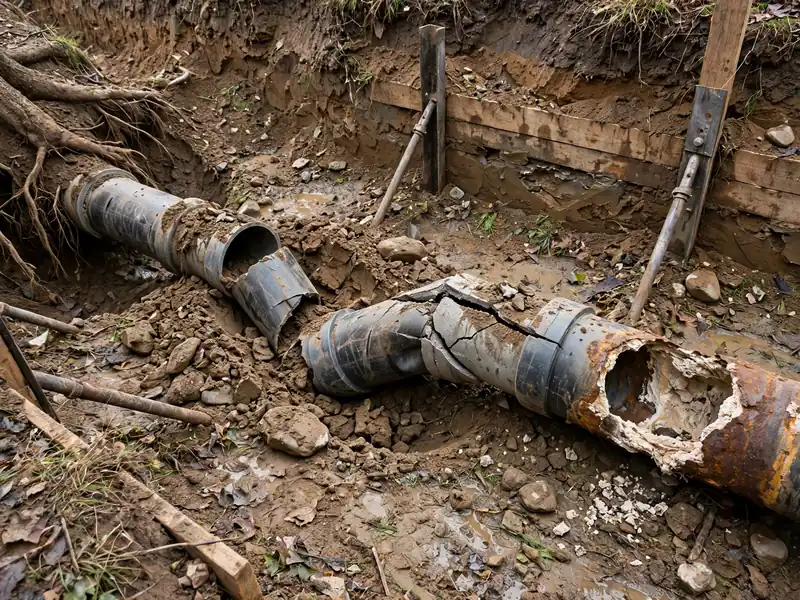
The Ground Beneath: Soil Movement and Water
Southaven's expansive clay soil is the area's defining damage cause. Clay swells dramatically when wet and shrinks when dry, and the annual cycle — spring saturation, summer baking — heaves the ground around buried pipes year after year. Rigid, jointed pipes (clay, cast iron) absorb this movement at their weakest points: joints separate, segments offset, and bellies form where the pipe settles into voids. Each cycle does a little more damage, and the process is invisible from the surface until symptoms appear.
Water itself is the second ground-level cause. Infiltration — groundwater entering the line through cracked joints — is both a symptom and a cause: it signals existing damage, and the water escaping back out erodes soil around the pipe, enlarging voids and undermining support. Southaven's heavy spring rains make infiltration a seasonal crisis for marginal lines. Poor surface drainage compounds it: yard grading that ponds water over the line's route keeps the surrounding clay saturated and maximizes both infiltration and soil movement. Controlling surface water — grading, gutters, downspout extensions — is one of the least expensive forms of sewer protection a homeowner can buy.
The Living Causes: Roots and Biology
Tree roots are Southaven's most famous sewer destroyer, and the mechanism is straightforward: roots detect moisture vapor escaping through tiny joint gaps, enter as hair-fine tips, and expand inside the pipe's ideal growing conditions — wedging joints apart, cracking segments, and eventually filling the bore with a woody mass. Mature oaks, maples, and pines in established neighborhoods have root zones extending far beyond their canopies, and in summer drought the sewer line becomes the most reliable water source around, accelerating growth toward it.
Biology works chemically too. Inside cast iron lines, bacterial colonies produce acids and the famous internal scale — tuberculation — that narrows the bore and pits the wall. Grease-eating bacteria are benign, but the hydrogen sulfide produced by anaerobic decomposition corrodes concrete and metal components, including the crown of concrete pipes and metal fittings. None of this is preventable in the absolute sense — it is what happens inside sewers — but it is manageable: root maintenance on a schedule, grease kept out of the line, and pipe materials (PVC, HDPE, CIPP) that resist biological attack far better than their predecessors.
The Human Causes: Misuse, Construction, and Neglect
What goes down the drain is the damage cause homeowners control most directly. Grease poured down kitchen drains congeals on pipe walls, narrowing the bore and catching debris — the number one preventable cause of residential slowdowns. So-called flushable wipes do not disintegrate; they snag on joints and roots and accumulate into blockages that stress the whole system. Harsh chemical drain cleaners corrode cast iron and older pipes while failing to clear the actual obstruction. Each is a choice, and each is avoidable.
Construction damage is the human cause nobody intends. Fence posts driven through laterals, landscaping crews trenching blindly, heavy equipment compacting or crushing shallow pipe, and DIY projects that nick the line — all common, all preventable with a located line marking before digging. Then there is neglect, the quietest cause: the line that is never inspected, the root intrusion left for five years, the rain-linked slowdown normalized as a quirk. Neglect does not damage the pipe directly — it lets every other cause work unopposed until the failure is total. A line inspected every few years, with problems addressed at the maintenance stage, rarely suffers the catastrophic failures that neglected lines produce on schedule.
Age, Installation Defects, and Putting It Together
Pipe materials age, and aging is a damage cause in itself: Orangeburg deforms, cast iron corrodes through, clay joints fail one by one. Southaven's pre-1980 housing stock is largely in this window now. But installation defects can make even young pipe fail early: inadequate bedding that lets the pipe settle into bellies, bad slope that strands solids, poorly seated joints that invite roots from day one, and backfill that was never compacted, settling for years and dragging the pipe with it. A 15-year-old line with installation defects can look worse on camera than a 50-year-old line that was bedded properly.
In practice, damage is almost always compound: an aging clay line (age) in heaving soil (ground) with oaks overhead (roots) and a homeowner pouring grease (misuse). Each cause amplifies the others — roots exploit the joints soil opened; grease catches on the roots; the blockage stresses the weakened pipe. That is why the camera inspection is so valuable: it shows the actual combination at work in your line, and the repair plan addresses the combination, not just the loudest symptom. Fix the roots but ignore the belly, and the backups return. Line the pipe but ignore the surface drainage, and infiltration continues. Lasting repairs treat causes, all of them — which starts with seeing them. For a diagnostic inspection that identifies every cause affecting your line, call (833) 713-2101.
Frequently Asked Questions
What is the most common cause of sewer line damage?
It varies by neighborhood age, but the most common combinations in Southaven are tree root intrusion into aging clay joints and soil-movement damage from expansive clay. In newer PVC neighborhoods, the leading causes shift to construction damage and misuse (grease, wipes). A camera inspection identifies which causes are actually at work in your specific line — guessing wastes money on the wrong fix.
Can heavy rain damage my sewer line?
Rain does not damage a sound line, but it exposes and worsens existing damage. Infiltration through cracked joints overloads the line, escaping wastewater erodes supporting soil, and saturated clay heaves with maximum force. That is why Southaven's spring storms are peak failure season: the rain is the trigger, but the damage was already there. Lines that slow every time it rains are telling you they need repair.
Do garbage disposals damage sewer lines?
Not directly, but heavy disposal use contributes to the grease-and-solids load that builds up in lines — especially starchy, fibrous, and fatty waste in volume. A disposal used sensibly for small scraps is fine; one used as a trash can accelerates buildup that narrows the line and feeds blockages. Scrape plates into the trash and let the disposal handle the rinse-off.
How can construction damage my sewer line?
Fence posts, deck footings, and landscaping trenches can pierce shallow laterals; heavy equipment can crush them; and grading changes can alter drainage onto the line's route. Always have utilities located — and know your lateral's route — before any digging project. A free locate call prevents a five-figure line replacement.
Is sewer line damage always expensive to fix?
No — early-stage damage is often very manageable: a cleaning, a root treatment, a spot repair. Damage becomes expensive when it is ignored until it compounds — the root intrusion that becomes a collapse, the infiltration that becomes a washed-out void. The cost curve of sewer damage rewards early action steeply, which is why inspections at the first symptom are the wisest money in home maintenance.